

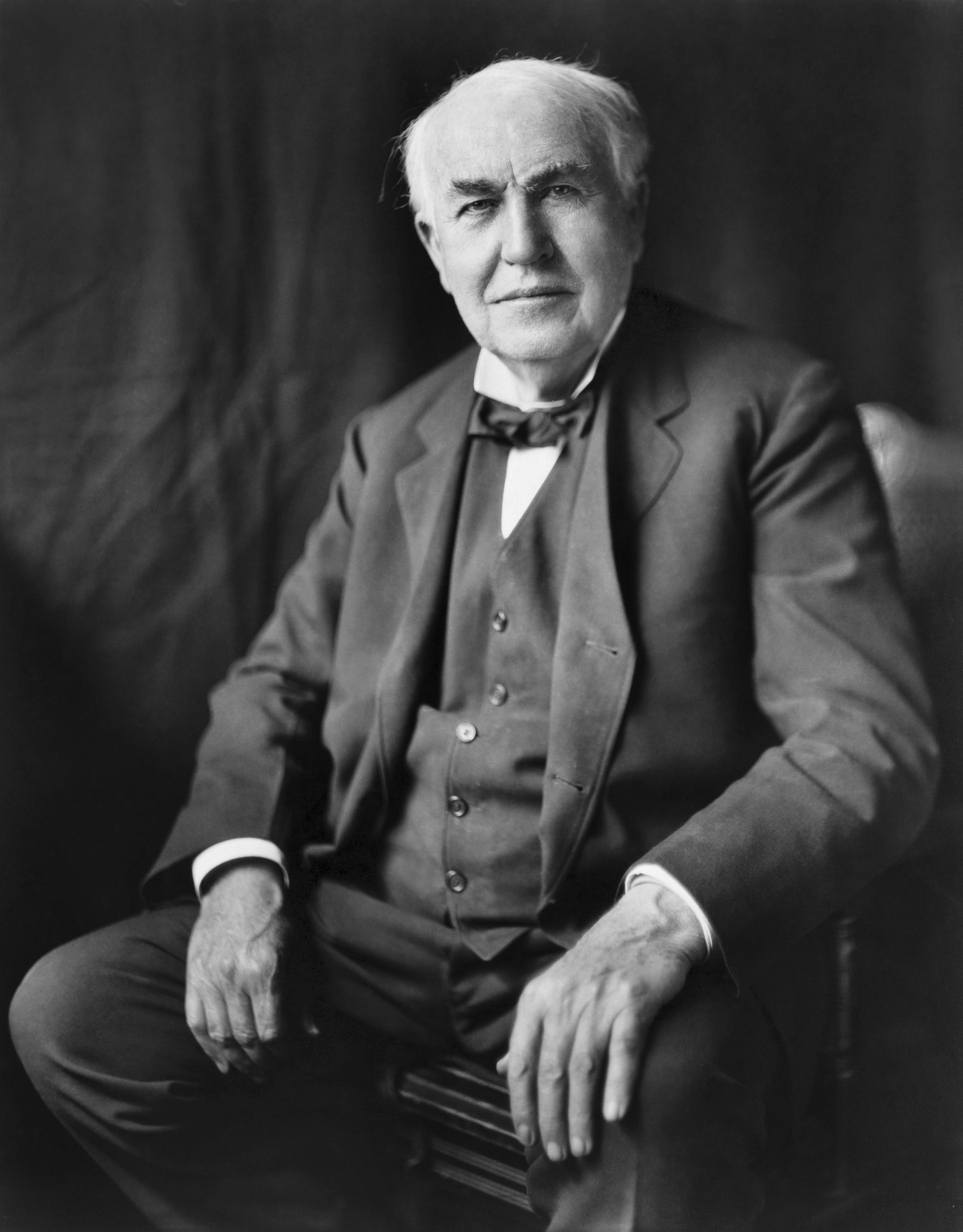
Thomas Edison registered a total of 1,093 patents in his lifetime.
He averaged one patent for every ten to twelve days of his adult life.
Most people assume this is because he was a genius.
But that’s not the full story.
While Edison did have above-average intelligence, what he had more than anyone else was an insane work ethic.
For most of his adult life, Edison worked for 18 hours per day, on average. He was so obsessed with working on new things that he often forgot to eat, sleep and bathe himself unless reminded by others. His employees would find him asleep in odd locations around the workshop where he had simply passed out from exhaustion after working for 72 hours straight.
The mental image that most people have of Edison is one of a genius who was struck by insights on how to create the light bulb, the phonograph, and hundreds of other world-altering inventions.
But the reality is that Edison was a workhorse. He even insisted that his greatest attribute was not genius, but patience.
“Edison had certainty that any idea, no matter how revolutionary, was realizable through sheer doggedness of experiment.”
As a child, Edison made a makeshift laboratory in the basement of his home to experiment with mixing different compounds.
When he got stuck and needed to learn about chemistry, he would simply sit and read through a textbook from cover to cover.
A friend once said of Edison:
“He was always studying something and usually had a book dealing with some scientific subject in his pocket.”
At age 15, Edison famously studied for 18 hours per day for several months straight to learn Morse code so he could become a telegraph operator.
In his first job as a telegraph operator, it was required for him to send a certain code each hour to show that he was actually working. He figured out a way to automate this by hooking up a notched wheel to an office clock that transmitted the exact code each hour for him so that he could instead spend his time reading on the job.
By age 20, Edison had become one of the fastest telegraph operators in the nation.
At age 22, he moved to New York City and began to make a name for himself with his inventions. This is when he began receiving money from investors, which allowed him to quit his job as a telegraph operator and work full time on inventing.
Fast forward to age 29. Edison bought land in Menlo Park, New Jersey and built a house and laboratory. He chose this location because it allowed him to get away from the distractions of Manhattan while still being close enough to allow for business trips and delivery of supplies.
He would spend the next two decades working intensely on creating an efficient light bulb and figuring out how to provide electricity to the city of Manhattan.
It was during this time that Edison hired Nicola Tesla, who remarked that he was so impressed with Edison who:
“…had no training at all, no advantages, and did it all himself by virtue of his industry and application.”
That quote is worth reading twice.
Nicola Tesla, another giant in the history of human inventions, attributed Edison’s success to his industry and application, not innate genius.
While it famously took Edison over 10,000 failed experiments to perfect the light bulb, he was never fazed.
As he once remarked:
“If I find 10,000 ways something won’t work, I haven’t failed. I am not discouraged, because every wrong attempt discarded is just one more step forward.”
Edison viewed failures as stepping stones to success, stating:
“Many of life’s failures are people who did not realize how close they were to success when they gave up.”
As Edison entered his 50’s, 60’s and beyond, he stuck to his 18-hour daily work schedule, only occasionally taking time off.
If there’s one grand misconception about Thomas Edison, it is that he was able to churn out invention after invention simply because he was a genius.
But the facts tell a different story.
Edison was patient and persistent. He brought new inventions to the world through doggedness.
The real “secret” to his success was the number of repetitions he put in, the hours he spent pouring over textbooks, and the immense time spent behind closed doors in his laboratory tinkering with new technology.
People referred to Edison as the “Genius” of electric light. But he insisted he was no genius…unless the definition of genius is prolonged patience.
“I’m patient enough, to be sure.” - Thomas Edison
My book notes came from reading Edison by Edmund Morris.